Rocket Pool's
Saturn I Upgrade
Rocket Pool's next protocol is bringing a long list of improvements to the protocol.
Saturn includes a series of tokenomic, user experience & efficiency upgrades to make it easier to spin up & maintain your validators.

First, a protocol recap...
Building on a 7+ years-long heritage of industry-leading innovation, Rocket Pool has continued to push the boundaries of decentralised liquid staking since launch - with a number of successful protocol upgrades.
Rocket Pool vision and early alpha
Rocket Pool published its ETH2 vision and shipped early alpha builds, then ran multiple public beta phases that refined minipools, token mechanics, and operator UX.
Mainnet launch of Rocket Pool
Rocket Pool launched to Ethereum mainnet with rETH for liquid staking and permissionless node staking via minipools, opening the protocol to public stakers and operators.
Redstone/Atlas era preparation and The Merge support
Ahead of Ethereum’s Merge, upgrades discussed in Atlas threads aligned tokenomics, smoothing pool mechanics, and the client stack for post‑Merge proof‑of‑stake operations.
Atlas upgrade
Atlas reduced bond sizes to allow 8 ETH minipools and improved protocol efficiency and UX - enabling more operators to participate and decentralizing validator supply.
Houston upgrade
Houston delivered major protocol improvements, including governance and operational safety tooling, and set foundations for future tokenomics changes and megapool concepts.
Saturn 0 and (upcoming) Saturn I
Saturn 0 was introduced in October 2024 and removed the mandatory RPL bond for new minipools and shifted RPL to earn ETH via a commission share, simplifying entry while keeping incentives for RPL staking.
Saturn One is set to halve the operator bond to 4 ETH and introduce megapools, express/standard queues, and adjustable commission controls—further improving capital efficiency and operator UX. These enhancements (and others) are listed in detail below.
Setting the stage for Saturn One: Saturn Zero
On 28 October 2024, Rocket Pool went through a significant change: a tokenomics update allowed new validator minipools to be launched without an RPL token bond.
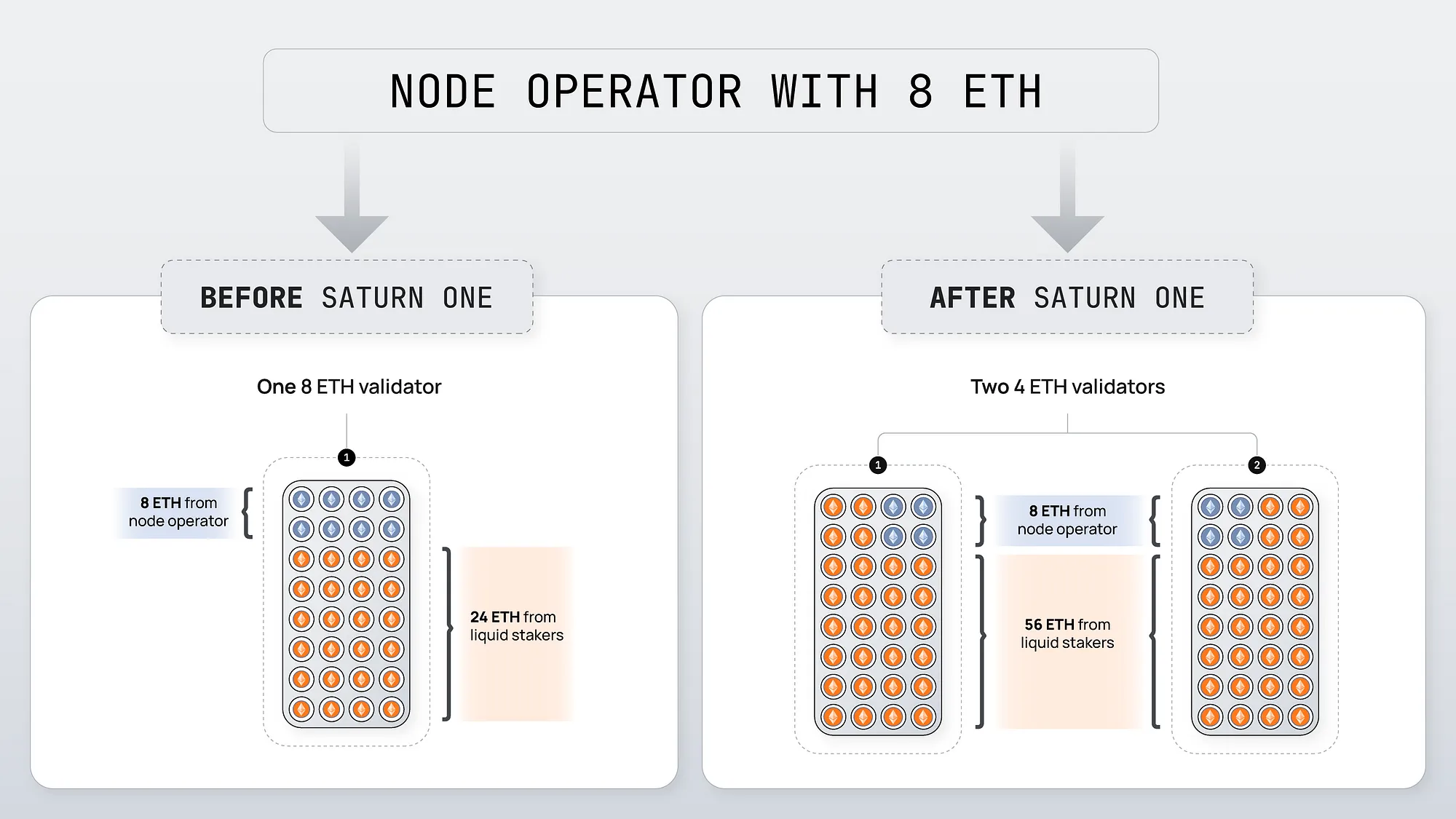
Consequently, node operators now only need to contribute 8 ETH, with 24 ETH being matched from liquid staking deposits. RPL tokens are now optional for staking, but provide boosted ETH commission return should the node operator so choose to stake them.


2021
Launch with 16 ETH minipools

2023
Atlas brought 8 ETH minipools

2024 - 2025
Saturn 0 - Optional RPL
Saturn I Features
What is Saturn I bringing?
Increased Capital Efficiency
With Saturn One, the node operator ETH requirement will be halved to just 4 ETH, further lowering the financial barrier to entry and more than doubling Rocket Pool’s overall potential capital efficiency.
Saturn Zero: 8-ETH minipools
Under Saturn Zero today, a node operator with 8 ETH can support 24 ETH of liquid staking deposits totalling the 32 ETH needed for each validator.
Saturn One: 4-ETH minipools
With Saturn One, that same 8 ETH will be able to create two 4 ETH validators, supporting a total of 56 ETH in liquid staking deposits across both validators.Press enter or click to view image in full size
Protocol Revenue
Perhaps the most exciting component is flicking the protocol-wide fee switch for RPL. In its first iteration, a portion of the protocol’s ETH staking rewards will be redirected to staked RPL.

Dynamic Protocol Revenue Flows
The split of the protocol’s ETH revenue between RPL revenue, node operator commission, and rETH rewards can be changed dynamically by the DAO to be nimbler and more responsive to market conditions.
Megapool Gas Savings
More efficiency means more minipools, and unfortunately that means more gas. Thankfully, Rocket Pool is building a solution.
Today, each minipool is a discrete smart contract, but MEGAPOOLS will allow a node operator to group multiple minipools under a single contract, effecting significant efficiencies for anyone who is validating-with-size.
Deposit Process
Express queue access will be managed via tickets, allocated based on historical minipool bonding to reward long-term participation.
Minipool delegate
Validators will be linked to a delegate contract, enabling reward routing and withdrawals to a single address per node.
Deploying minipool
Node operators will deploy a single megapool per node, consolidating all validator withdrawals and reducing gas costs.
Deposit validator
Operators will submit validator credentials and withdrawal addresses to enter the queue for ETH assignment from the shared deposit pool.
Assign ETH from deposit pool
ETH will be assigned to validators in two steps — a 1 ETH prestake to lock queue position, followed by full staking.
Stake validator
Validator creation becomes a permissionless two-step process: after a 1 ETH prestake, anyone may trigger the remaining 31 ETH deposit to the beacon chain, activating the validator.
Standard & Express queue
Saturn introduces two queues: a standard queue and an express queue. Current node operators receive express queue tickets, allowing them to prioritize their validators.
Express ticket allocation
Express queue access will be managed via tickets, allocated based on historical minipool bonding to reward long-term participation.
ETH Reward Distribution & Penalties
Saturn introduces an updated reward model with built-in safeguards to ensure fair ETH distribution and penalization for protocol violations.
ETH Reward Distribution & Penalties
Rewards from validators will be split between rETH holders and node operators, with debt repayment prioritized before operator claims.
ETH capital distribution
When validators exit, the node operator bond is returned. Any excess is treated as unclaimed funds and may be withdrawn after debts are cleared.
Claiming funds
Node operators will be able to claim available rewards and capital from their megapool after satisfying any outstanding debts.
Commission controller
A configurable commission controller will be launched, allowing the pDAO to dynamically adjust revenue splits among participants.
Security Council Adder
This contract allows the security council to adjust the commission split within predefined bounds, serving as a governance safety mechanism.
oDAO penalisation of stake with guardrail
Saturn 1 adds guardrails for the oDAO to cap how much can be penalized over time, protecting against abuse.
Distributor, Solo & Guardrails
Saturn introduces structural and safety improvements, allowing for protocol growth without sacrificing control or reliability.
Protocol upgrade guardrails
A mandatory delay period will be enforced before protocol upgrades go live, during which the security council can veto changes.
Balance submission guardrail
Saturn introduces constraints on oDAO-submitted balance data, protecting the rETH protocol rate from manipulation or faulty reporting.
Audit & Beta Testing
Before mainnet launch, Saturn components will undergo robust audits, bounties, and test deployments to ensure reliability.
Security audits
All critical contracts and logic will be reviewed by third-party auditors for vulnerabilities and correctness.
Bug bounty update
An expanded bug bounty program will incentivize researchers to find and report issues ahead of launch.
Staging release
Saturn will be deployed to a staging environment to simulate real-world conditions and test integration end-to-end.
Final beta testing
The community and node operators will participate in final beta rounds to validate functionality and provide feedback.
Mainnet Launch
Saturn 1 will be deployed to Ethereum mainnet, introducing major protocol enhancements to support Rocket Pool’s long-term growth.
oDAO upgrade governance
The pDAO has authorized the upgrade through a governance vote, while the oDAO will be responsible for executing Saturn 1 on-chain after the mandated delay.
Celebrations and much joy!
Saturn’s launch will mark a major milestone for Rocket Pool — improving scalability, operator UX, and protocol sustainability.
FAQs
Find answers to your most common questions about the latest improvements, enhanced features, and how these changes benefit you.
It depends on the total value locked (TVL), the RPL price, and how much RPL is staked across the network. Rewards are variable and based on your share of the total staked RPL.
Yes — you can use the speculative RPL fee switch calculator here: https://rpl-fee-switch.streamlit.app/
In Saturn 1, staked RPL earns ETH rewards from a portion of node operator commission instead of just receiving inflationary RPL.
No — the ETH/RPL ratio doesn’t affect your migration timing. You won’t lose anything by migrating early, though eventually the existing RPL rewards may be reduced or phased out to encourage migration.
Once Saturn 1 is live and you update your node, you can start using the new system — including migrating to cheaper 4 ETH validators in a megapool and earning ETH rewards from the commission switch.
No. Rocket Pool validators will remain at 32 ETH. The protocol is specifically designed around 32 ETH per validator, and Saturn does not change that.
Got More Questions?
You can find a helpful community of node operators and staking enthusiasts on the Rocket Pool Discord. To learn more about staking with Rocket Pool you can visit the official documentation.
Resources
Documentation, guides, and technical specifications for implementing Saturn upgrades.